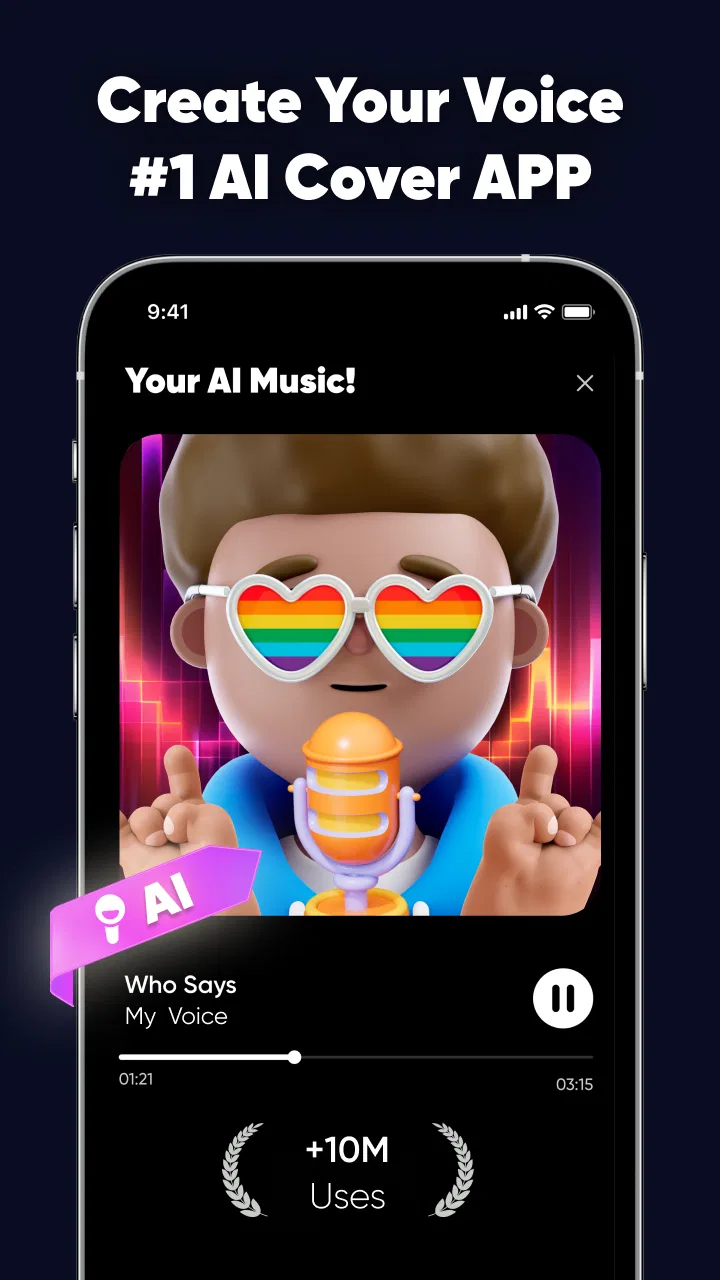
VocalMe Music: AI Cover Songs
- 3.5
- Rating
- 100.00K
- Installs
- Free
- Price

 Analysis by App-foxy
I tried VocalMe Music: AI Cover Songs with a simple goal: turn the idea of hearing a familiar song in another vocal style into something I could explore without setting up a full recording project. That starting point matters, because this is not really aimed at people who want a complete digital audio workstation. It sits in the Music & Audio category as a focused AI voice and cover-song app, and its appeal comes from making experimentation feel more immediate.
The first impression is easy to understand. You choose the kind of vocal result you want to explore, provide the musical material the app accepts, and wait for the generated outcome. The interesting part is not just pressing a button; it is deciding what to submit, how much quality to expect, and whether the finished cover is useful for your purpose. In my experience, the best results come when I treat it as a creative sketchbook rather than a replacement for a singer, producer, or professional studio.
That distinction will save you some disappointment. If you want a quick way to imagine a song with a different vocal character, this app can be entertaining and practical. If you need exact pitch control, detailed mixing, polished mastering, or dependable commercial-ready audio, the usual recording and editing tools remain a better fit. VocalMe Music is most convincing in the space between curiosity and a finished demo.
You May Also Like

 Pandora - Music & Podcasts
Pandora’s Music Is Easy to Start, but Harder to Recover
Pandora’s strength is its low-effort path from a seed to a station. Its weak spot is how much confidence it asks you to place in connection, setup, and quiet recovery.

 AccuWeather: Weather Radar
AccuWeather Review: A Quick, Clear Forecast for Everyday Decisions
For everyday plans, the best forecast is the one you can understand quickly. AccuWeather makes rain timing, radar, and local conditions easy to act on, with a few trade-offs.

 Hill Climb Racing
Why Hill Climb Racing Still Turns Crashes Into One More Run
A tiny car, a bumpy hill and one more upgrade: Hill Climb Racing keeps resurfacing because its simple chaos makes every near-miss feel personal.

 AliExpress - Shopping App
AliExpress Makes Global Shopping Feel Personal, but Shoppers Bear the Risk
AliExpress turns a global marketplace into a pocket-sized discovery engine. Its reach is useful, its shopping loop compelling, and its trade-offs easy to miss.

 Lords Mobile: Kingdom Wars
Lords Mobile Is a Kingdom-Building Routine, Not a Quick Match
A case-by-case verdict on the building, battles, device demands, and social commitments that make Lords Mobile rewarding for some players and exhausting for others.

 PDF Scanner app - TapScanner
TapScanner Makes Paperwork Easier to Capture, Check, and Share
TapScanner makes scanning with a phone feel less like a rescue operation and more like a dependable step in getting work done. Its capture tools are useful, though not flawless.
More From Our News Desk
View All News


From song idea to generated cover
When I move from a song idea to a generated cover, I find it helps to decide what I want to learn before I start: whether the melody holds up, the mood changes, or a different vocal character suits the track. That small choice makes listening more useful than simply judging whether the result sounds impressive. Next, I look at what happens when I push the workflow harder and where its limits become more noticeable.
Beginning with the right expectation
The app is free to install, which makes it simple to test before deciding whether it belongs in your regular music workflow. It is published by TALENT ME TECH. and is suitable for Everyone, so the basic proposition is approachable rather than aimed only at trained musicians. At the same time, optional in-app purchases range from around five dollars to around fifty dollars per item, so I would explore the free experience carefully before spending money.
Its audience is broader than singers. A casual listener might use it to hear a playful reinterpretation of a favorite track. Someone writing a song could use a generated vocal idea to judge whether a melody feels convincing before asking a real vocalist to record it. A creator working on a private concept video might also use the output as a temporary guide. The common thread is speed: you want to move from an idea to an audible example without learning a complicated production environment.
Before starting, I recommend choosing a source with a clear vocal line and a reasonably clean arrangement. Busy instrumentation makes it harder to judge what the generated voice is doing. This is one of the less obvious trade-offs: a song that sounds exciting in ordinary listening may be a poor test because layered backing vocals, heavy effects, or dense percussion leave less room for a convincing transformation.
Preparing the input instead of rushing to generate
The input stage deserves more attention than the store summary suggests. AI cover tools are often judged by their final button, but the material going in strongly shapes what comes out. I would first decide whether I am testing a complete song, a short section, or a particular chorus. A short, recognizable passage is usually more useful for comparison than an entire track that contains several changes in mood and arrangement.
I also listen for the vocal qualities I want to preserve. If the original performance relies on breathy phrasing, sharp consonants, or dramatic pauses, I pay attention to whether those details are central to the song’s identity. A generated cover may capture the broad vocal idea while smoothing over the small human imperfections that made the original memorable. That is not automatically a flaw, but it changes the purpose of the result.
For a practical workflow, I keep the first attempt deliberately simple. I do not try to evaluate every possible style at once. Instead, I make one version that should stay close to the source and another that takes a more noticeable creative direction. This creates a useful comparison: the first helps me judge clarity and timing, while the second shows whether the app is adding an interesting interpretation or merely changing the surface of the vocal.
Moving through the generation step
Once the material and intended vocal direction are clear, the app’s central workflow is straightforward in concept. I select the cover approach, start the generation, and wait for the processing to finish. The waiting period is part of the handoff between my creative decision and the app’s automated work. I am no longer shaping every note manually; I am giving the system a set of choices and accepting that some musical details will be interpreted for me.
That handoff is convenient, but it also explains why the result may not match the mental version in my head. A traditional vocalist can respond to a producer’s correction, and a manual editor can move a phrase, adjust a note, or change an effect. An automated generator works from the material and direction it receives. If the source is ambiguous, the output can expose that ambiguity rather than solve it.
My advice is to listen to the first result diagnostically. Do not ask only, “Do I like it?” Ask whether the words remain understandable, whether the phrasing follows the song, whether the vocal sits naturally over the music, and whether the new voice supports the mood. Those questions tell you what to change in the next attempt. If the words are unclear, a different source section may help. If the mood feels wrong, the vocal direction may need to be less extreme.
Using the output as a working handoff
The generated cover becomes more useful when it is treated as an intermediate asset. I can imagine sending it to a friend for a quick reaction, using it to compare two arrangement ideas, or keeping it beside a lyric draft while deciding which section deserves a full recording. In that role, the app saves time because it produces something concrete enough to discuss.
This is especially helpful for people who struggle to evaluate a melody silently. A written chorus can look promising on a page and feel awkward when heard. A generated vocal gives me an immediate reality check. It may not be the final performance, but it can reveal that a line is too high, that the chorus arrives too soon, or that the emotional lift is not as strong as expected.
There is also a useful separation between composition and performance. I can focus on the song’s structure first, then decide later whether the final version should feature my voice, another singer, or a conventional instrumental arrangement. That makes VocalMe Music a reasonable companion during early development, particularly when I need a rough audible reference rather than a polished release.
What the finished result is good at
The strongest outcome is a fast creative preview. When the source is suitable and expectations are realistic, the generated cover can make a familiar musical idea feel new enough to inspire another step. It is fun for casual experimentation, but I found its practical value more interesting in songwriting and planning. Hearing an alternate vocal presentation can expose strengths and weaknesses that are easy to miss when listening only to the original.
For a personal project, the result can function as a mood board in audio form. I might use it to decide whether a song should feel intimate, dramatic, playful, or more restrained. I would not confuse that with a finished production, but it is still a meaningful result because it shortens the distance between imagination and evaluation.
The app can also be useful for people who are not confident singers. Instead of abandoning an idea because they cannot immediately perform it, they can explore the concept through an AI-generated vocal treatment. That does not remove the need for musical judgment. It simply gives the idea a temporary voice while the creator decides what deserves more work.
Where the workflow becomes less comfortable
The main friction comes from the loss of fine control. In a conventional music app, I can edit individual notes, adjust timing, automate volume, choose exact effects, and balance instruments around the vocal. Here, the central attraction is automation, so the process is faster but less granular. If a single phrase sounds wrong, I may have to rethink the input or try another generation rather than repair that phrase directly.
That trade-off becomes important for serious vocal production. A singer and producer can make expressive choices in response to lyrics, arrangement, and emotional context. An AI result may sound technically interesting while missing the intention behind a line. It can also make a performance feel too uniform, especially when the song depends on subtle changes in intensity.
I would also be cautious about using an output as if it were automatically ready for public release. A generated cover can be useful for private experimentation and planning, but publishing music involves responsibilities around the underlying song and the material used to create the result. The app’s convenience should not replace your own judgment about rights, permissions, attribution, or whether the finished audio meets the standards of the platform where you want to share it.
How it compares with ordinary alternatives
Compared with a standard music player, VocalMe Music offers participation rather than simple playback. A player is better when I only want to listen to the original recording, manage a library, or enjoy music without creating anything. This app makes sense when the question is, “What would this song feel like with a different vocal treatment?”
Compared with a digital audio workstation, it is much less demanding to start but much less flexible afterward. A workstation wins when I need multitrack editing, detailed arrangement changes, recording control, or a carefully mixed final track. VocalMe Music wins when I want a fast concept and do not want the setup burden of building the vocal chain myself.
Compared with recording my own voice, the choice depends on the goal. My own recording carries personal character and gives me direct control over interpretation, but it may require practice, a suitable room, and editing. The AI route is quicker for trying possibilities, yet it can feel less personal and may not express the lyrics with the same intention. I see the two approaches as complementary: use the generated version to test the idea, then record a human performance when the idea proves worth pursuing.
Who should try it, and who should skip it
I would recommend it to curious listeners, beginning songwriters, short-form content creators working on concepts, and anyone who enjoys hearing alternate vocal possibilities. It is a good match for a person who values quick iteration more than deep control. The free entry point also makes it reasonable for casual testing, provided you keep the purchase options in mind before committing to paid items.
I would skip it if my priority were professional vocal editing, exact arrangement control, or a predictable release-ready master. I would also choose a conventional recording setup if the emotional detail of the singer is the entire point of the project. An AI cover can suggest a direction, but it should not be expected to replace the judgment, responsiveness, and character of a real performance.
Practical questions before installing
One question many people will have is whether they need musical training. I do not think advanced theory is necessary to enjoy the app or test a cover idea. Basic listening skills are more important: knowing what part of a song you want to change and being able to notice whether the result fits. Musicians may get more value from it because they can turn the result into a structured songwriting decision, but beginners can still use it as an approachable experiment.
Another question is whether it works best for complete songs or small sections. My preference is to begin with a focused passage, especially a chorus or a verse with a clear melody. That makes the outcome easier to judge and reduces the chance that one weak section will make the whole result seem unsuccessful. After finding a direction that works, I would consider expanding the idea rather than starting with the most ambitious possible test.
People also wonder whether paying is necessary. Since the app is free to install and includes in-app purchases, I would not assume that every useful workflow requires payment, nor would I buy immediately. I would first learn how the basic experience handles my type of material, decide whether the output is genuinely useful, and only then consider whether a paid item fits my budget and purpose.
Device compatibility is another practical point. The app supports Android devices running version eight or later, which covers a broad range of phones but still makes the operating-system requirement worth checking before installation. The current release is version two point nineteen point five, so I would keep the app updated through the normal store process when possible, particularly if the generation workflow changes over time.
My final take after following the full workflow
After moving from song selection to generated cover and then treating the result as a creative handoff, I see VocalMe Music as a specialized idea-testing tool rather than an all-purpose music studio. Its value appears when I want an audible answer quickly: does this melody work with a different vocal identity, does this chorus carry the intended mood, or is this concept worth recording properly?
The app has a 3.5 average from around three thousand ratings, alongside more than one hundred thousand installs. That suggests a noticeable audience, while also reminding me that the experience will not satisfy everyone equally. AI-generated music is inherently sensitive to source quality and personal expectations, so the same output that feels playful to one listener may feel too limited to another.
My recommendation is to approach it with a clear workflow: choose a clean and focused musical passage, define the creative question before generating, compare the result against that question, and use the output as a draft rather than a final verdict. The best reason to use VocalMe Music is not to avoid music-making, but to make the next creative decision faster. With that mindset, it is an enjoyable free app for exploring cover-song possibilities. Without it, anyone seeking detailed control or a finished professional production will probably be happier with a recording and editing tool built for that job.
FAQs for VocalMe Music: AI Cover Songs
01What is VocalMe Music: AI Cover Songs?
VocalMe Music: AI Cover Songs is an AI-powered music app designed to create cover versions and experiment with vocal performances. After exploring the app, its main appeal is the ability to transform song ideas with artificial voices and different musical styles. It is aimed at casual listeners, creators, and users who enjoy discovering how familiar songs might sound with another vocal approach.
02How does VocalMe Music create AI cover songs?
The app generally relies on artificial intelligence to process a selected song, vocal concept, or supported input and generate a new cover-style result. Depending on the available tools and subscription level, you may be able to choose voices, genres, or other presentation options. Processing time can vary, especially when the service requires an internet connection or cloud-based generation.
03Is VocalMe Music: AI Cover Songs free to use?
VocalMe Music may be available to download without an upfront payment, but some features, generations, voices, or listening options can be restricted by in-app purchases or a subscription. Before starting a trial, carefully review the pricing page, renewal terms, and cancellation instructions shown in the app store. Availability and prices may also differ between Android and iOS.
04Can I use and share the AI-generated cover songs commercially?
You should not assume that every song created with VocalMe Music can be used commercially or uploaded freely to social media. Copyright in the original composition, recording, lyrics, and any recognizable voice may belong to other parties. Check VocalMe’s current terms, the app’s usage policy, and the rules of the platform where you plan to publish the result before monetizing or distributing it.
05Does VocalMe Music require an internet connection and what permissions does it need?
Many AI music applications perform generation on remote servers, so VocalMe Music may require a stable internet connection for creating, processing, or streaming covers. The app could request access to storage, audio files, or the microphone if those features are supported on your device. Review each permission request carefully, deny anything unnecessary, and check the privacy policy before uploading personal recordings.
Pros
- Creates AI song covers in multiple vocal styles.
- Simple interface makes generating covers quick and accessible.
- Useful for experimenting with original lyrics and melodies.
- Offers a fun way to compare different vocal interpretations.
- Can inspire songwriting and creative music projects.
Cons
- Vocal results may sound artificial
- especially on complex songs.
- Generation quality can vary noticeably between tracks.
- Some features or voice options may require paid credits.
- Copyright rules may apply when sharing generated covers publicly.
- Processing can take longer during busy periods or on weaker devices.

VocalMe Music: AI Cover Songs
Gallery